
Integrated Development and Production: A Buyer's Decision Framework
The decision to buy development and production from one partner is a control decision before it is a price decision. Integrated development shortens the schedule and reduces handovers, and it also concentrates dependence on a single relationship, which is a real cost when something goes wrong. For a festive gifting range the question becomes sharper, because a fixed shelf date punishes delay more than it punishes most other problems. The framework below ranks the four questions that actually decide the model, then shows where each model puts the risk.
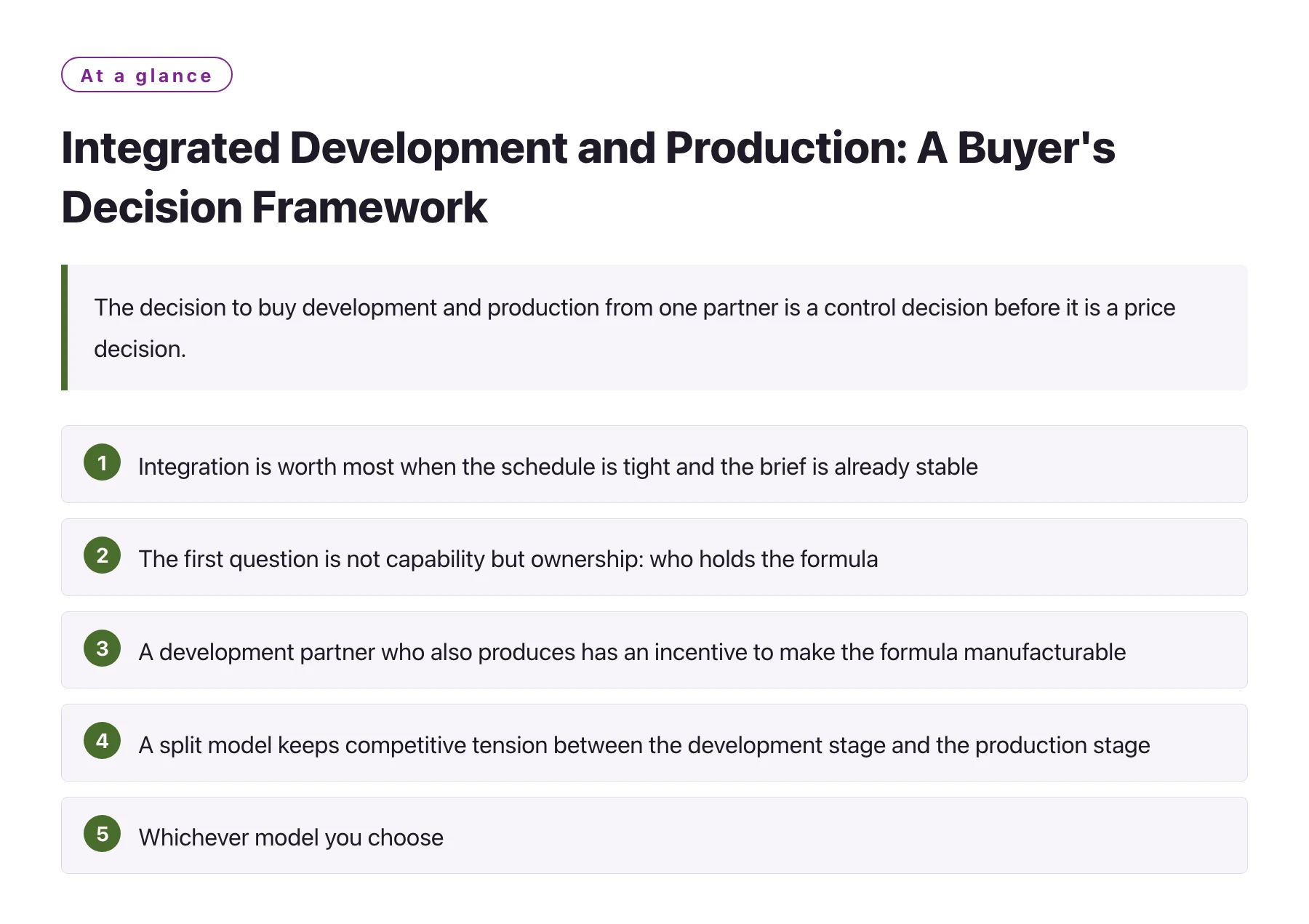
Key takeaways
- Integration is worth most when the schedule is tight and the brief is already stable; it is worth least when the brief is still moving and you need the freedom to change partners mid-project.
- The first question is not capability but ownership: who holds the formula, the reference sample and the design files after the project ends.
- A development partner who also produces has an incentive to make the formula manufacturable, which reduces the reformulation risk that appears when the two stages are split.
- A split model keeps competitive tension between the development stage and the production stage, at the cost of an extra handover and an extra set of documents.
- Whichever model you choose, the safety assessment route and the release criteria should be named in writing before the festive calendar makes them urgent.
Founders often frame this decision as build versus buy, and then reduce it to a single comparison of prices. That framing hides the part that matters: integrated development and production is a different risk shape, not simply a different number. It removes handovers and adds dependence; it shortens the schedule and narrows your options if the relationship sours.
This article is written for the person who has to make that call and then defend it to a co-founder or an investor. It does not argue that one model wins. It sets out four questions in the order that actually resolves the decision, then compares the models on the dimensions that tend to cause trouble in a festive range.
Four questions, in the order that resolves the decision
Answer them in sequence. Each one narrows the set of sensible options, and answering them out of order is how buyers end up negotiating price before they have decided what they are buying.
One: how frozen is the brief?
If the scent direction, the format and the pack are settled, integration is straightforward and mostly beneficial. If the brief is still moving, integration can lock you into a partner before you have learned what the product is. The honest test is whether you can describe the product in two sentences without hedging; if you cannot, you are buying development, not production.
It also helps to know what a development stage can legitimately include. The large fragrance houses publish material about their own development approach, and reading one is a useful calibration for what a brief can ask for at each stage. [1]
Two: who owns what afterwards?
Ownership of the formula, the reference sample, the moulds and the artwork files is the question that decides your leverage later. Integrated partners sometimes retain the formula by default, which is reasonable commercially but should be an explicit, priced decision rather than a clause you discover at the end.
Ask it early, because the answer affects everything else. If you do not own the formula, a split model is not really available to you later, whatever the contract says about performance.
Three: how much schedule risk can you absorb?
Count the handovers each model requires and multiply by the realistic queue at each one. Integrated development typically has fewer, which matters most when the date is fixed. A split model adds at least one transfer of both goods and documents, and transfers are where a two-week delay becomes a four-week one.
Four: what does the exit look like?
Before signing, imagine the project ending badly and ask what you would still have: the formula, the files, the reference, a second approved supplier, or nothing. A model that leaves you with nothing is acceptable only if the price genuinely reflects that. Most buyers find that answer changes their preferred model, which is why it belongs in the decision rather than in the contract review.
The three common models and where each puts the risk
| Model | What you keep in-house | Where the risk sits | Fits when |
|---|---|---|---|
| Fully integrated development and production | The brief, the brand and the commercial relationship | Concentrated in one partner, which is efficient until it is not | The brief is settled, the date is fixed and the format is standard |
| Development with a specialist, production with a factory | The formula and the creative direction, usually | At the handover, where the factory must reproduce someone else's formula | The scent is genuinely differentiated and worth protecting |
| Production only, from a library direction | Nothing technical; the brand and the packaging | Low execution risk, high differentiation risk | The festive range must ship on time and the scent is not the differentiator |
| Scent developed with a specialist, gift pack assembled by a second partner | The formula, the creative direction and the pack design | At assembly, where two suppliers share responsibility for one finished unit | The set design is distinctive and the scent is worth developing separately |
The third row is underrated. Many festive gifting ranges are bought for their presentation, and a scent taken from an established library with a light adaptation is a reasonable commercial choice. The mistake is paying for bespoke development and then managing it as though it were a library selection. The middle row carries the most documentation burden, which is why it benefits from a partner who already publishes how it handles a transferred formula; the scope of full ODM fragrance service is a useful comparison point when you are weighing that against full integration.
The decision sequence, in practice
- Write the brief in two sentences and test whether it is stable. If it is not, decide explicitly that you are buying development first and production later.
- Decide ownership before price: formula, retained reference, moulds, artwork files and the right to move them.
- Map the handovers each candidate model requires, and put a realistic queue time against each one.
- Ask each supplier to describe its release criteria and who signs them, rather than asking whether quality is guaranteed.
- Confirm the safety assessment route and who commissions it, in writing, before the festive calendar closes.
- Write the exit into the agreement, including what you receive and at what cost if the relationship ends.
Why this is worth settling before the festive season
A festive range compresses the consequences of structural decisions. In a standing line, a poorly chosen model can be corrected over two or three orders. In a seasonal range there is one order and one shelf date, so the model you chose in spring is the model you live with in December.
That is also why the choice should be made with the compliance route in view. Where a safety assessment is required, a committee opinion or an equivalent assessment is not a formality that can be produced on demand at the end; it depends on information assembled during development. [2] A partner who can name the route and the responsible party during the decision conversation is demonstrating that the process exists before it is needed.
If you want to sanity-check a candidate before deciding, look at the history of the organisation you would be depending on. The story of the company behind the factory is not a substitute for due diligence, but it does tell you how long the operation has been running and what it has been running on, which is relevant when the stakes are a single seasonal run.
One workable compromise deserves mention: integrate development and production for the festive range, and in parallel commission an independent evaluation of the formula you end up with. It keeps the schedule benefit of one-stop fragrance development while giving you a second opinion that is not commercially invested in the outcome. The due diligence checklist for due diligence on a perfume manufacturer covers the same ground from the supplier side, and the two together are a reasonable minimum before a first seasonal commitment.
A simple way to keep the decision honest: write down what would have to be true for you to choose the other model. If nothing plausible appears on that list, you are not deciding, you are confirming a preference. Buyers who can articulate the counter-case tend to negotiate better terms, because they know what they are giving up.
Sources
- dsm-firmenich —— A global fragrance, flavour and nutrition company; public information on perfumery, ingredients and sustainability programmes.
- EU Scientific Committee on Consumer Safety (SCCS) —— The EU scientific committee that issues opinions on the safety of cosmetic ingredients, including fragrance allergens and their labelling thresholds.
Frequently asked questions
Is one-stop fragrance development cheaper than splitting the work?
Not necessarily, and the comparison is not like for like. Integrated development removes handovers and their hidden costs, but it also removes competitive tension at the production stage. The reliable approach is to compare total landed cost and schedule risk, not the two headline fees.
Who owns the fragrance formula in an integrated project?
It depends entirely on the agreement, which is why it should be decided explicitly rather than assumed. Some integrated partners retain the formula and license its use for your product; others transfer it. Either can work, but the practical consequence is your ability to move production later, so the term matters more than it appears to.
What is the biggest risk in a split development and production model?
Reproducing someone else's formula in a different plant. Small differences in equipment, materials and process can shift the result, so the handover needs a retained reference, a written process specification and a documented first-batch comparison. That is all doable, but it has to be planned rather than assumed.
Can I start with a library direction and develop something bespoke later?
Yes, and for a festive range with a fixed date it is often sensible. The risk is paying for bespoke development while managing the project as if it were a library selection, which wastes both the development effort and the schedule benefit you were trying to buy.
How do I check a partner before committing an entire seasonal range?
Ask for the release criteria, the retained reference procedure, the safety assessment route and an example of a deviation and how it was handled. Then find out who you would be dealing with in six months. A seasonal range is a single-shot commitment, so the process matters more than the presentation.