
Turning a Repayment Schedule into Terahashes per Month
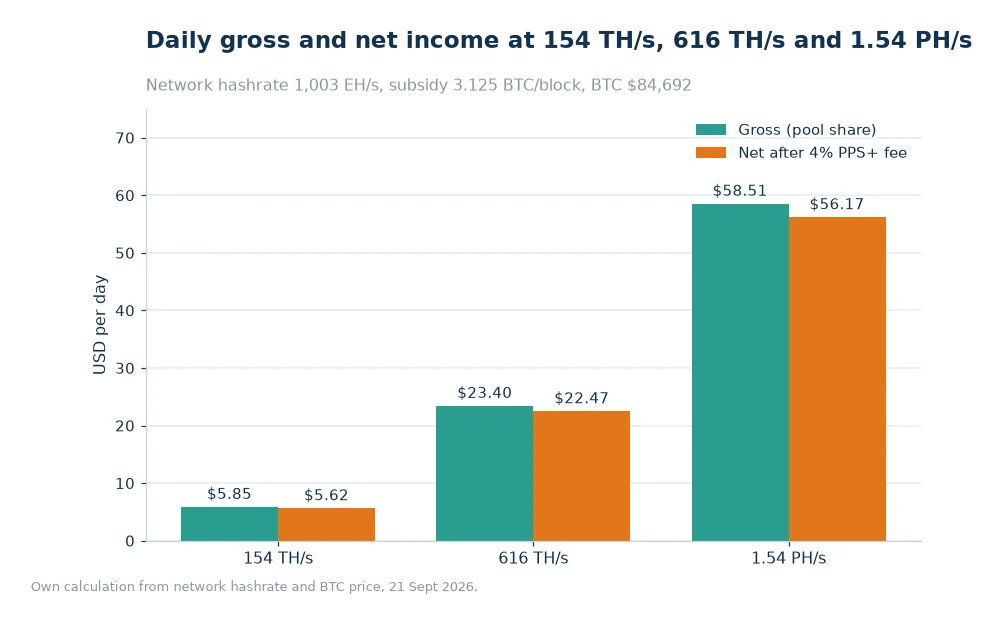
A loan instalment is a dollar amount, but a miner's income is a hashrate. Translating one into the other makes the obligation legible: at 154 TH/s the net output is 5.62 USD a day, so a 200 USD monthly instalment is about 1.2 times everything that machine produces. The same instalment spread across a 1.54 PH/s rack is a far lighter burden, and the difference is arithmetic rather than optimism.

Key takeaways
- 154 TH/s nets 6.909e-05 BTC a day, or 5.62 USD at $84,692 after the listed 4%.
- A 200 USD monthly instalment equals roughly 35 days of one such machine's net output.
- Adding collateral at the start lowers the monthly figure and raises the amount that must be repaid later.
- Schedule payments a day after settlement, so the balance is never funded by a coin that has not arrived.
Express the instalment as output
Monthly dollars and daily coins meet at a single conversion. Take the daily net output of the hardware, multiply by the days in the month, and compare the result with the instalment. That ratio tells you how many machines are effectively working for the lender rather than for the power bill. A ratio below one is comfortable; a ratio above one means the loan is being serviced by something other than the rig it was raised against.
The conversion also exposes term length. A twelve-month schedule on a machine with a three-year competitive life uses a third of that life to clear the debt, which leaves two years of unencumbered output. A twenty-four-month schedule uses two thirds and leaves much less. Neither is wrong, but the second leaves very little room for a difficulty rise or a repair, and that is the risk the term is really pricing.
Do the conversion with the hashrate you actually have, not the one on the purchase order. A unit that benches at 154 TH/s in a cool room delivers less in a warm shed, and the repayment ratio moves with it. Using the label figure quietly assumes the best case for the whole term.
A repayment table built from net income
The rows below move the hashrate, not the instalment. Read the weekly column as the amount available before power and before the lender is paid.
| Hashrate | Net per day | Net BTC per day | Net per week |
|---|---|---|---|
| 154 TH/s | $5.62 | 0.00006909 | $39.34 |
| 616 TH/s | $22.47 | 0.00027634 | $157.29 |
| 1.54 PH/s | $56.17 | 0.00069085 | $393.19 |
Notice that the weekly figure is not a round multiple of the daily one in any meaningful planning sense; it is simply seven days of the same rate. The useful comparison is between the weekly total and the weekly instalment, because a weekly rhythm matches how many operators actually review their books. A monthly total hides a bad week; a weekly one does not.
Add Collateral is a buffer, not a formality
The first step in a Collateral-Pledged Loans position is adding collateral, and the temptation is to add exactly the minimum the platform requires. That produces the lowest locked balance and the highest monthly instalment, which is the wrong trade for a miner whose revenue can dip for a week. Adding a margin above the minimum lowers the instalment and creates room for a price fall without a new decision.
The cost of that margin is real: the extra coins are locked and cannot be sold. Treat it as an insurance premium rather than as lost liquidity, and size it against one bad month rather than against a worst-case year. A buffer that is too large ties up capital that could buy another machine; a buffer that is too small turns a routine dip into an emergency. The ViaBTC Crypto Loan screen sets the minimum requirement, but the decision about how far above it to sit belongs to the operator.
Worked example
Take the 154 TH/s row and turn a 200 USD instalment into days of output.
- Each terahash earns 450 ÷ 1,003,000,000 = 0.00000044865 BTC a day at this reading.
- At 154 TH/s the daily figure is 0.00006909 BTC.
- In dollars, 5.85 before the pool takes anything.
- The 4% listed on the block-reward stream leaves 5.62.
- A 200 dollar instalment therefore equals 35.6 days of output.
- Over thirty days the machine contributes 168.60, leaving 31.40 to find elsewhere.
- At 616 TH/s the month is 674.10 and the same 200 dollars takes 29.6% of it.
If difficulty rises in the middle of the term
A schedule built on today's difficulty assumes the network stops growing. It rarely does. If network hashrate rises by ten percent, each terahash produces about nine percent less, and the monthly contribution falls by the same proportion. At 616 TH/s a 674 USD month becomes roughly 613 USD, which is still comfortable against a 200 USD instalment but no longer leaves the same surplus.
Run the sensitivity before the draw: a ten percent rise, a twenty percent rise, and a month of half uptime. If the instalment survives all three, the structure is robust. If it survives only the first, the term is too short or the draw is too large. The next adjustment was estimated at −2.12% when the inputs were read, but an estimate is a direction, not a guarantee, and the plan should not depend on its sign.
Keep the loan ledger apart from the pool ledger
Two sets of numbers are easy to blur: what the pool paid and what the loan consumed. Keep them in separate columns even if they sit on the same page. The pool column is coins and hours; the loan column is principal, interest and dates. Blurring them makes a good month look like a good decision and a bad month look like a pool problem.
Pay from settled funds. PPS+ credits hourly, so a payment scheduled two days after the statement date has already been funded by coins that cleared. The pricing page shows what the pool retains, and the Profit Calculator will project the revenue side at a hashrate you choose. Neither replaces the ledger, but both keep it honest, and a ledger kept for six months will tell you more about your own operation than any projection.
Frequently asked questions
How many days of mining does a 200 USD payment cost?
At 154 TH/s, about 35.6 days of net output at 5.62 USD a day, which is more than a month; at 616 TH/s the same payment takes about 8.9 days.
Should I add more collateral than the minimum?
A margin above the minimum lowers the instalment and creates room for a price dip, at the cost of locking coins that could otherwise be sold, so size it against one bad month rather than a whole year.
What if network hashrate rises during the loan term?
Each terahash then produces less, roughly nine percent less for a ten percent rise, so test the instalment against a ten and twenty percent increase plus a month of half uptime before committing.
Set the payment date after the payout hour
Pick a date when the coins are already in the account, not one that depends on a payment landing that morning. Then check the ratio once a month: instalment divided by net output. If it drifts above the level you set at the start, the fix is a partial repayment or a longer term, not a bigger machine bought on credit. The habit is dull, and dull is what a repayment schedule should be.
Sources: ViaBTC's loan and pricing pages, covering the pledge sequence and the 4% listed on the block-reward component[1]. Readings from 21 Sept 2026: 1,003 EH/s network hashrate, 132.76 T difficulty, 3.125 BTC per block, 144 blocks daily, $84,692 per BTC. Source figures read 21 Sept 2026, published 24 Oct 2026. Monthly totals assume thirty days of uninterrupted hashing.