
Custom Stainless Steel Jewelry for Everyday Wear
A piece worn eight hours a day is a different engineering problem from a piece worn to a dinner. Contact points, edge radii, clasp tension and coating thickness decide whether the design survives a desk, a gym and a shower. The published stainless route starts at 100+ pieces per design, with 3D CAD inside 48 hours and sampling at 25–30 days.
Key takeaways
- Daily wear fails at contact points first, so geometry decides service life before alloy does.
- 316L carries 2–3% molybdenum and is the grade published for shower and swim use.
- A brushed or textured finish hides fine scratches that a high-gloss polish reveals.
- Custom stainless work starts at 100+ pieces per design with a 48–60 day path to delivery.
Everyday wear is a mechanical problem first
Most jewelry faults that customers describe as tarnish begin as abrasion. A ring rubs against a keyboard, a bracelet rests on a desk edge, a chain catches on a coat collar. Each contact removes material at a rate set by pressure and surface finish, and a coated surface loses its colour where the coating goes.
Designing for daily wear therefore starts with shape. A wide flat band contacts more surface than a domed one. A square edge chips a coating faster than a radius. A heavy pendant on a thin chain concentrates load at the bail. None of those is a metal problem, and none is solved by choosing a more expensive alloy.
The same reasoning applies to weight. A piece that feels substantial in the hand may be tiring by the end of a working day, and a piece that feels light may deform. The approved sample has to be worn, not only inspected.
Ring width and wall thickness trade weight against rigidity. A 2 mm band feels light and bends under pressure; a 6 mm band holds its shape and sits heavier on the finger. The right figure depends on the wearer, but the sample should be tried on a hand rather than judged on a tray.
Chain and clasp choices follow the same logic. A lobster clasp with a firm spring survives daily use better than a trigger clasp that opens against a pocket lining. A cable chain resists kinking where a fine rope chain does not. The published customisation list treats chains and findings as a separate decision, which is a useful prompt: the chain is part of the wear experience, not packing material.
Stone settings deserve the same attention. A prong setting traps grit and moisture; a closed back holds moisture against the skin. Neither is wrong, but the choice should follow the use the product is sold for. The manufacturing page at www.tttjewelry.com/stainless-steel-jewelry-manufacturer/ states the two grades and the minimum order in one place, which is the quickest way to test whether a design fits the route before a sample is built.
Finishes that meet a desk, a gym and a shower
The factory sequence separates high-gloss polishing from brushed and textured surface art, then plates. That order matters for daily wear. A gloss surface shows scratches within weeks on a ring, while a brushed surface scatters light and hides them. A texture applied before plating also gives the coating a mechanical key on the metal.
On stainless steel the colour comes from PVD vacuum plating over a 316L or 304 body, and the published claim ties the 316L combination to shower and swim use. On 304 the description is water-resistant for daily wear. The difference is about chlorides and about how much exposure the product is designed to take, not about which grade is made with more care.
Anti-tarnish e-coating is published for silver and brass rather than for the stainless route. A buyer moving a design from brass to stainless should expect the protection to come from the metal and the PVD film rather than from an added organic layer. Buyers weighing a warmer tone against steel can compare the custom brass jewelry line, where the e-coating does that work and the MOQ is 100 pieces.
Briefing the sampling bench
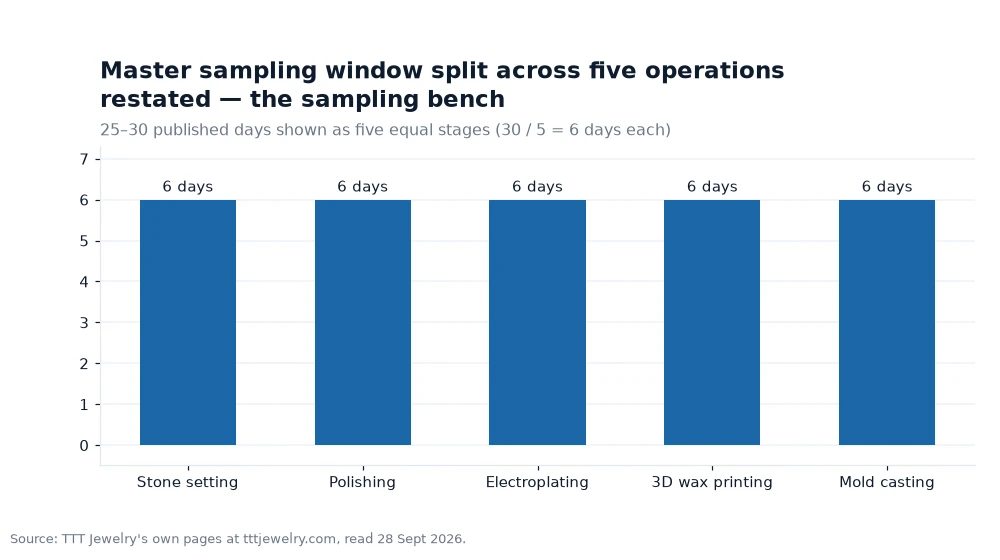
Sampling is where a daily-wear design is proved or corrected. The published window is 25–30 days after CAD, and the CAD stage runs under 48 hours. That ratio is the practical argument for detail in the model: two days of modelling against a month of bench time.
A brief that shortens the loop names the alloy, the finish on each surface, the edge radius, the clasp type, the setting method and the engraving position. Vague briefs produce samples that are close but not right, and every correction costs another 25–30 days. The dedicated project manager and the 100% NDA are the two process pieces that keep revisions inside one channel.
Batches are inspected in full before delivery, so a fault found at final QC is caught on every piece rather than on a sample of it. That is also why the first approved sample matters: it becomes the physical reference for the whole run.
Wear points and design responses
The table lists the places a daily-wear piece usually fails and the design decision that answers each one.
| Wear point | What happens | Design response |
|---|---|---|
| Ring inner edge | Rubs against skin and neighbouring fingers | Round the edge before polishing |
| Chain link joints | Metal moves against metal | Choose a link pattern with room to move |
| Clasp | Repeated opening under load | Match clasp size to the chain weight |
| Pendant bail | Load concentrates at a single point | Thicken the bail or spread the load |
| Stone setting | Grit and moisture collect under prongs | Fix the setting type at CAD stage |
None of those rows adds a material cost on its own. They add modelling time, and modelling time is the cheap part of the schedule. A radius drawn into the file costs minutes; the same radius added after a sample costs a full sampling round.
Worked example
Take three everyday designs at the published stainless minimum: 3 × 100 = 300 pieces before the first reorder. Set the calendar beside the quantity. CAD at 48 hours is 2 days, sampling is 25–30 days, production is 21–28 days.
The shortest path is 2 + 25 + 21 = 48 days; the longest is 2 + 30 + 28 = 60 days. A second sampling round adds 25–30 days to whichever figure applies, so one extra revision moves a 48-day launch to 73–78 days.
The CAD share is small and worth calculating. 48/600 = 8% of a 25-day sample window and 48/720 = 6.7% of a 30-day window. Two days of modelling is between 6.7% and 8% of the month that follows it, which is why design changes belong before the file is released rather than after the first sample arrives.
Frequently asked questions
Is 316L stainless suitable for a ring worn every day?
The published description covers shower and swim use for 316L, which carries 2–3% molybdenum, and the PVD route supplies the colour.
Which finish hides scratches on a daily-wear piece?
A brushed or textured surface scatters light and shows fine scratches less than a high-gloss polish, and the factory applies that texture before plating.
How long does a custom stainless sample take?
CAD takes under 48 hours and the physical sample takes 25–30 days, after which mass production runs 3–4 weeks.
From approved sample to a repeat order
A daily-wear design is proved on the bench, not in the brief. Once the sample passes, the repeat order becomes a scheduling exercise rather than a development one, and the per-unit arithmetic improves because the tooling already exists. Brands building a second metal into the same collection can compare the sterling silver jewelry manufacturer route, where the minimum falls to 50 pieces and the metal itself carries the value.
Source note: figures come from the manufacturer's own website (tttjewelry.com), read 28 Sept 2026.[1]